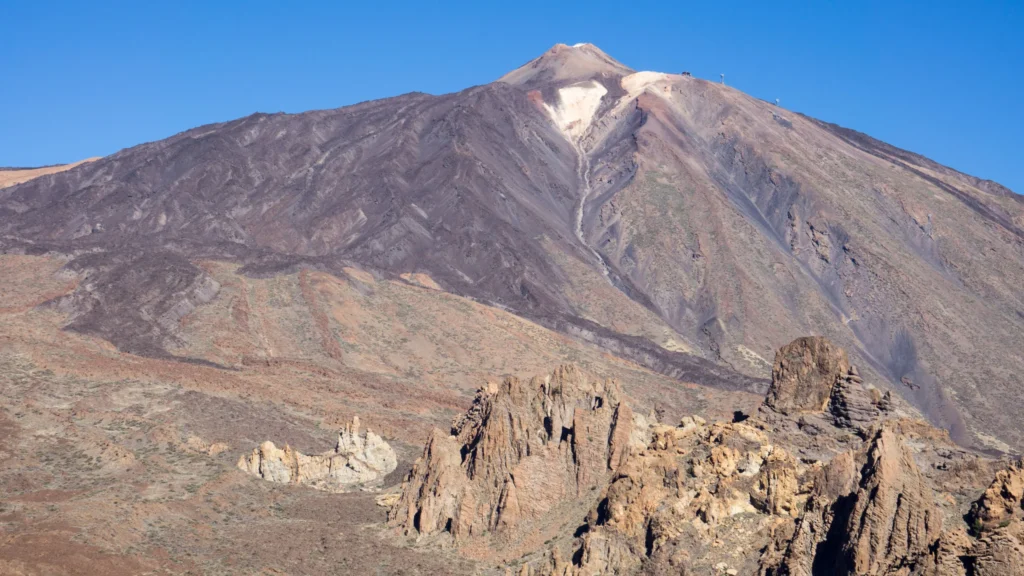
Quick answer: Pico Viejo is the second great volcano of the Teide‑Pico Viejo complex, with a crater about 800 metres across whose rim sits at around 3,100 metres. There are three ways to see it: from the Pico Viejo viewpoint, next to the upper cable car station; from the Narices del Teide viewpoint, on the TF‑38 road; or along the PNT 09 trail, which needs a booking on Tenerife ON.
Independent, unofficial information website. Permits are booked on Tenerife ON.
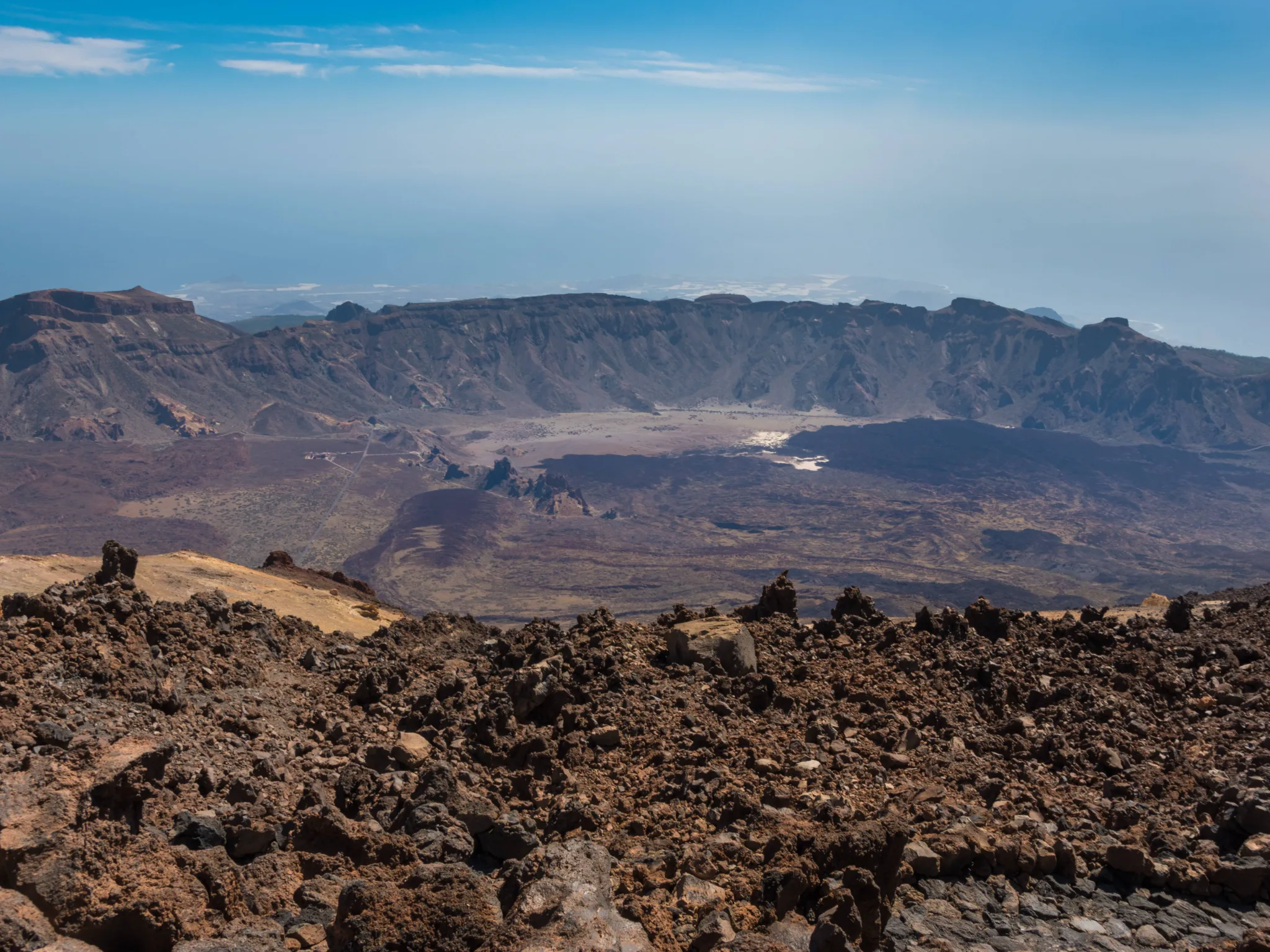
What Pico Viejo is
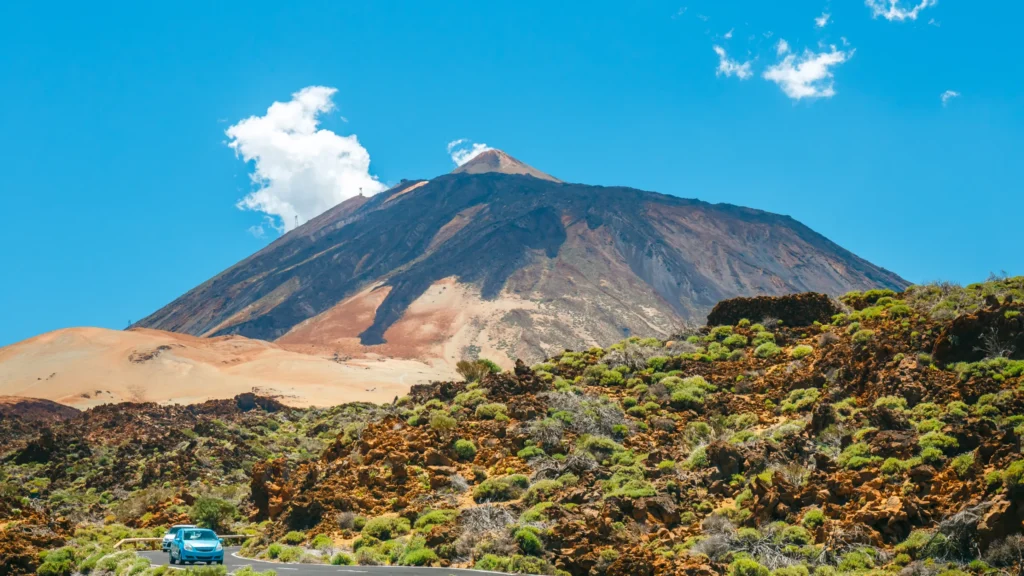
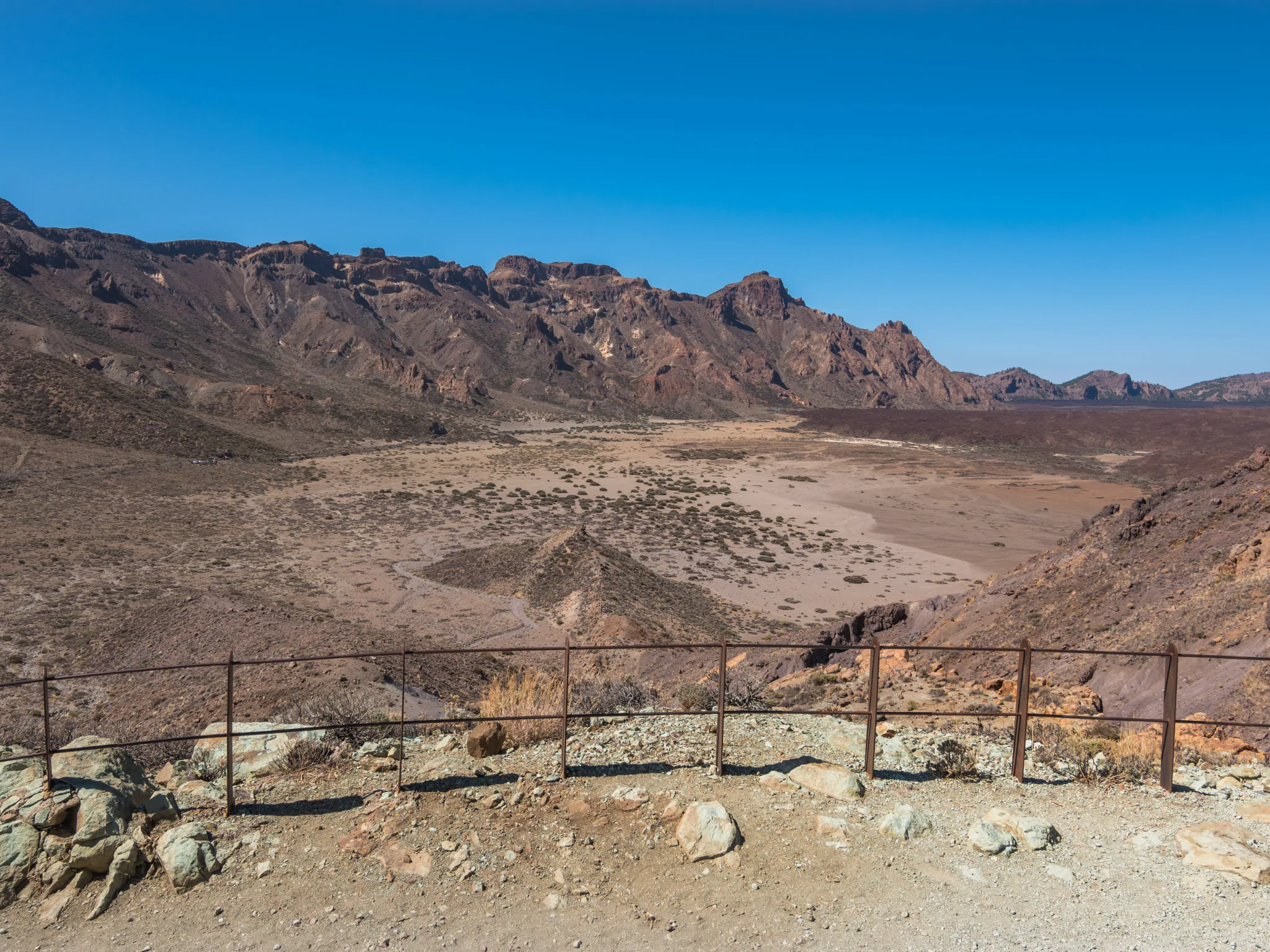
Pico Viejo and Teide form a single stratovolcano. From Las Cañadas you’ll see it to the left of Teide as a large dark mass, lower and wider, topped by a huge crater. At its foot, to the west, lie the Narices del Teide («Teide’s nostrils»): a line of eruptive vents that opened in 1798, in what was the last eruption inside the national park.
The lava flows running down from Teide’s summit towards Pico Viejo date from medieval times and come from the summit’s last eruption. That’s why the landscape looks so fresh: black, with hardly any vegetation.
- 800 mdiameter of Pico Viejo’s crater
- ≈ 3,100 maltitude of the crater rim
The Pico Viejo viewpoint at La Rambleta
It’s the easiest way to look into its crater. From the upper cable car station, at 3,555 metres, a signposted trail leads to the Pico Viejo viewpoint (PNT 12). It’s a short walk but with loose rock and altitude, so take it slowly and wear closed shoes. On very clear days you can see as far as the western islands.
Tenerife ON describes it as a short, well-surfaced walk among fumaroles, but warns that the altitude reduces the oxygen available and can be exhausting: walk slowly and rest whenever you need to. These are the figures from its official page (PNT 12 trail):
This viewpoint isn’t one of the trails that require a permit. You only need a Teide cable car ticket.
- 0.72 kmlinear, from La Rambleta
- −66 mof descent (and 21 m of ascent)
- 3,499 maltitude of the viewpoint
- Openno booking needed; medium difficulty (MIDE)
The Narices del Teide viewpoint
On the TF‑38 road, which links Las Cañadas with Chío, there’s a viewpoint where you face the Narices del Teide vents and the slope of Pico Viejo with its lava flows. You can drive there and no permit is needed. At sunset the low light picks out the shapes of the volcano. It’s included in our pick of the best Teide viewpoints.
According to the official PNT 09 page, the Narices del Teide viewpoint is at km 3.2 of the TF‑38, exactly where that trail ends.
The PNT 09 Teide – Pico Viejo – Mirador de las Narices trail
- 9.61 kmlinear, point to point
- −1,605 mof total descent (and 192 m of ascents)
- 3,499 mstart; ends at about 2,086 m
- 5 h 10 minaccording to the official page, high difficulty (MIDE)
- Start
- Information panel at the Pico Viejo viewpoint, next to La Rambleta
- End
- Narices del Teide viewpoint, km 3.2 of the TF‑38
- Municipalities
- La Orotava and Guía de Isora
- Links with
- PNT 09.1, PNT 12, PNT 23, PNT 28, PNT 32 and PNT 38
- Permit
- Compulsory, on Tenerife ON, valid in both directions on the chosen day
- Places
- Every Monday at 07:00 places open for the following 56 days
- Gradient under 10 %
- 10 to 20 %
- Over 20 %
See the profile data as a table
| Km | Altitude | Section gradient |
|---|---|---|
| 0.00 | 3,499 m | |
| 1.00 | 3,235 m | -26 % |
| 2.00 | 3,060 m | -14 % |
| 3.00 | 3,031 m | -11 % |
| 4.00 | 2,748 m | -29 % |
| 5.00 | 2,553 m | -7 % |
| 6.00 | 2,365 m | -18 % |
| 7.00 | 2,223 m | -20 % |
| 8.00 | 2,068 m | -20 % |
| 9.00 | 2,091 m | +8 % |
| 9.61 | 2,086 m | -3 % |
In the direction of the official page, the trail drops below 3,000 m around km 3.1 and below 2,500 m around km 5.3. The steepest descent is between km 3.7 and 3.9: 71 metres down in 200 m (36 %). The lowest point, 2,048 m, comes around km 8.4, and the last kilometre climbs gently back up to the road.
It’s one of the toughest routes in the park. It starts by the information panel at the Pico Viejo viewpoint (La Rambleta), drops over black lava to the Degollada de Chahorra, skirts Pico Viejo to the south below the rim of its crater and descends to the Narices del Teide, finishing at the TF‑38 via the Lomo de Chío.
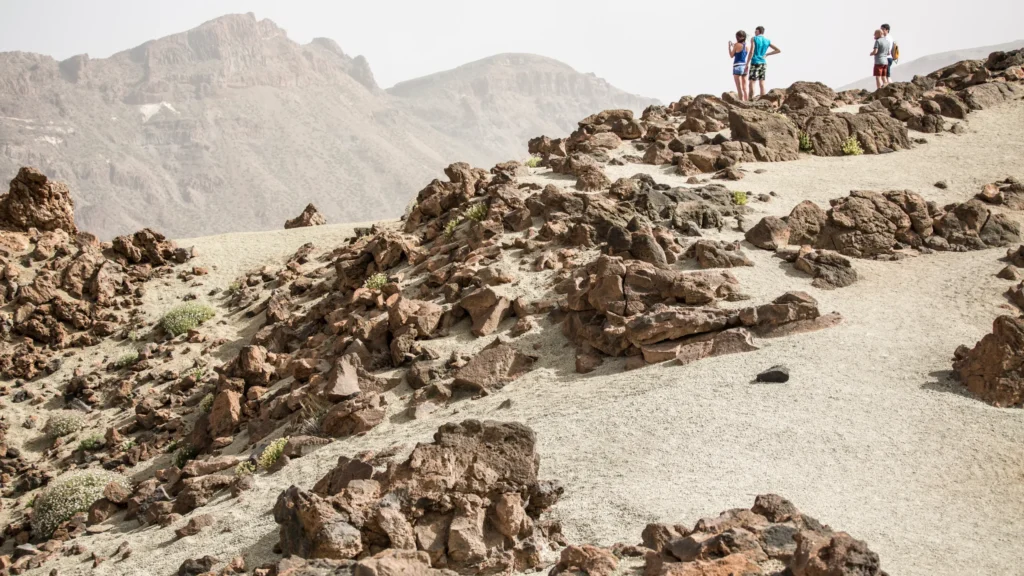
The section over dark lava is the hardest: the path is somewhat faint and the rock is uneven. Only for people with mountain experience and the compulsory gear (mountain footwear and a warm layer; with ice or snow, crampons and an ice axe).
If you’re thinking of climbing Teide from this side, remember that the last stretch to the summit needs the PNT 10 permit.
Frequently asked questions
How high is Pico Viejo?
The rim of its crater is at around 3,100 metres, according to Tenerife ON.
Do you need a permit to see Pico Viejo?
Not to see it from the viewpoints. You do to walk the PNT 09 trail.
How long does the PNT 09 take?
The official page allows 5 hours 10 minutes for its 9.61 km, almost all downhill: it loses 1,605 m of altitude between the Pico Viejo viewpoint and the TF‑38. You need a booking on Tenerife ON and a plan for getting back from the end, which is a long way from the start.
When was the last eruption?
The last one inside the national park was the Narices del Teide eruption, in 1798.
Can you climb Pico Viejo in a day?
Yes, with a PNT 09 booking, good fitness and experience. Plan how you’ll get back from the TF‑38, because it’s a linear route.
Sources: Tenerife ON, PNT 09 and PNT 10 trail pages; official PNT 09 route with the profile calculated by Teide Inolvidable; PNT 12 trail page. Last reviewed: 16 November 2026. Cover photo: imehling, CC BY-SA 3.0, via Wikimedia Commons (cropped and resized).